“Hi, how are you? Not too bad, busy”. “Hey, how’s work? All good but busy”. If I had a dollar for every time I heard or said the word “busy” in a conversation. People seem to have no time. We whinge and complain that we wish we had more hours and days in the week to finish all our tasks.
The brilliant advancements in technology have seen us get to places faster than ever with faster trains, cars, and planes. We have “fast food”, faster games in sports, faster internet, computers, machines, delivery, and faster ways to get rich and to communicate … faster… faster… These have been marketed to ensure that we “save” time, so we can have “more time” and yet everyone you speak says: “I have not time”.
Brothers and sisters, there is something gravely wrong. We simply can’t keep running at this speed. Something will give in. Actually many things have already given in. We have little time for our children, family, hobbies, rest, bodies, little time for the poor and most vulnerable and for stopping and nurturing our spiritual life, especially prayer. We simply cannot keep going that way, because it is against our nature, out of tune with who we are. Against God’s design and desire for us.
Observe nature and laws of nature. Seeds, animals, human and living beings need time to grow and bear fruit. The law of progress in nature tells us that time is essential. But we seem to go against nature.
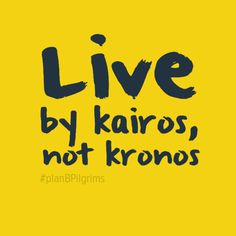
In Ancient Greek there were two words for time (Btw, Greek was the language of the New Testament). The two words are Chronos (χρόνος) and Kairos (καιρός). While the former refers to chronological or sequential time (Like minutes and seconds, days and week) and is quantitative; the latter signifies the right or opportune moment (the ‘supreme moment’) and is qualitative. Kairos relates to a period or season, a moment of indeterminate time in which an event of significance happens.
The Bible uses the word kairos and its cognates 86 times in the New Testament. Jesus’ first recorded sermon was simple: “The time (kairos) has come. . . The kingdom of God has come near. Repent and believe the good news!” (Mk 1:8). There was “an appointed time” for John the Baptist to be born when Zechariah was told by the Angel that he will remain mute because he did not believe the Angel’s “words”, which will be “fulfilled in their time (kairos)” (Lk 1:20). John the Baptist said in Mark 1:15 that “time (kairos) is fulfilled, and the kingdom of God is at hand.”
This is an appointed time which denotes a unique time in which something special was to happen, when God chooses to act. It is not a matter of which day, hour or second. The Gospels are not so interested in this way of counting time. For them, it is God’s time (kairos) coming through our time (chronos).
I guess there are two mindsets. The chronos and the kairos:
Our culture is addicted to chronos and we know this too well. We are rightly reminded that we have limited time here. Limited “chronos”, limited years and days. This thought alone can leave you in despair with so much to accomplish or crippled and you sit and do nothing. So we respond by rushing and “making the most it”. Let’s drink, party and go crazy, try everything for time is limited. Let’s try to cramp everything into our days. The outcome is no time to rest, to reflect, and to correct. We become so tense and stressed and the result is physical and mental illness, anxiety, fear, anger, violence and the lot.
Then there is the God vision. The kairos. Yes here also time is limited so let me make the most of it by choosing the right or opportune moments to do the right and opportune things. Here we must be open to the Holy Spirit to guide us to the places, the people, the conversations, the relationships to give “time or chronos” to. Here there is no need to fear chronos, the days and weeks as they pass by, rather you see them as gifts from God, a free gift that we have not worked for or earned. This fosters an attitude of gratitude and openness like Mother Mary to be guided by the Spirit, who “blows wherever it pleases” (Jn 3:8).
Here also time in prayer and contemplation becomes our daily bread. We will no longer be afraid of silence and see it as “a waste to time”. It becomes the kairos, the chosen time to slow down from life on the freeway, to recharge, fill up and drink from the fountain to life, from the well. As we drink, God will guide us to those “kairos” places and people who will bring us closer to Him.
So “let us not become weary in doing good, for at the proper time (kairos) we will reap a harvest if we do not give up” (Galatians 6:9).

 Burning Hearts